Emergency Broadcast System
Leave the World BehindThe Emergency Broadcast System becomes the blackout’s most visible public warning mechanism, yet it offers the household almost nothing beyond confirmation that ordinary life has been interrupted. Its repeated signal marks an emergency without explaining its cause, extent, or likely consequences. As television, phones, electricity, and water become unreliable in different ways, the system’s stark presence exposes the difference between receiving a warning and being able to act on one.
Identity and First Warning
The system enters the crisis through sound before its significance fully registers. Ruth explains that she heard a radio announcement repeating that this was the emergency broadcast system. She had initially overlooked it because she was accustomed to hearing the familiar disclaimer that a broadcast was only a test. The new repetition, without that reassurance, makes the message difficult to dismiss: it is not a routine test, even though it gives no further account of what is happening.
The same uncertainty appears in the household’s other devices. While listening from the dark hall, Amanda uses her phone as a light and sees a news alert from The New York Times reporting a major blackout on the East Coast of the United States. She tries to open it, but the application does not load. The alert offers a little more information than the broadcast, but not enough to explain the event, and the failed app prevents her from learning more. The system’s announcement and the stranded news alert thus arrive together as fragments rather than a coherent account.
The Television Signal and Its Limits
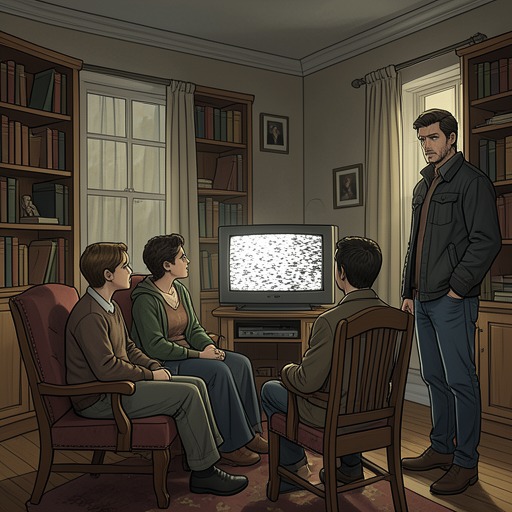
When Ruth turns on the television, the screen shows the emergency broadcast system in white letters against an old-fashioned blue field. Beeps punctuate a quiet hiss; the sound continues steadily, but its regularity is not reassuring. The others come into the living room to see the message for themselves. Amanda initially treats a blackout as an emergency in the general sense, while Clay hopes that changing channels will restore the program they had been watching.
Ruth scrolls through the available stations, beginning with channels 101 through 104 and then moving among 114, 116, 122, 145, and 201. Each displays the same blue field and meaningless words. The television therefore confirms that the problem is not confined to one channel, but the repetition supplies no new content. Clay reasons that a system would tell them more if there were more to tell; that confidence turns the absence of information into an unwarranted reassurance. Ruth, by contrast, connects the blank television to the house’s unreliable satellite service and to the remoteness she had wanted when she wrote its Airbnb listing. A place deliberately set apart from the world now has no dependable way to hear from it.
Household Recognition and False Reassurance
The message’s meaning shifts as the crisis continues. In the morning, Rose tells Amanda that something is wrong with the television. Amanda first answers that it is not an emergency, then remembers the system’s announcement and revises her certainty. The screen itself offers a concrete sign of worsening reception: the first channels show black-and-white dancing light, while those that follow are entirely white. Yet the bedside clock continues ticking, and the household still has electricity. Amanda can infer that there is some kind of blackout, but she cannot determine its scope or what will happen next.
This mismatch between a functioning warning signal and an unexplained crisis recurs in the family’s practical concerns. Amanda wonders whether the power may fail and urges Clay to go, while G. H. explains that water depends on an electric pump filling a reservoir. The household’s access to water is therefore not guaranteed by the fact that its lights remain on. He anticipates that residents of the uppermost apartments in Manhattan will later become delirious as dehydration sets in. The warning system has not supplied this consequence; people must piece together their vulnerability from knowledge of the infrastructure around them.
A Wider Communications Failure
The system’s limited message belongs to a breakdown broader than the television signal. Even as the pool’s filtration system begins its scheduled cycle at 10:00 a.m., confirming that power still operates at the house, communication elsewhere is faltering. The narrator describes towns in New Mexico and Idaho where events have not yet reached the same point, but people cannot seem to communicate with satellites overhead. Governors declare states of emergency without finding a way to tell the public. The simultaneous persistence of some local routines and failure of wider communication makes the crisis uneven and difficult to interpret.
The Emergency Broadcast System is consequently neither an explanation nor a reliable guide through the events. It identifies an emergency, and its repeated, unmistakable signal distinguishes the moment from an ordinary test, but the household receives no accompanying account or instructions. That gap gives the system its narrative force: a society can still produce the formal sign of warning while losing the channels, services, and shared understanding that would make warning useful.